Why large EVs need a different home charging conversation
Compact EVs like the Chevy Bolt use roughly 3 to 4 miles of range per kilowatt hour under normal conditions. Large EVs like the Rivian R1T and R1S use closer to 2 miles per kilowatt hour or less, particularly in Minnesota winters with four-wheel drive engaged. That difference compounds at home. A circuit that restores 60 miles overnight for a compact EV may only restore 35 to 45 miles overnight for a Rivian. For an owner who regularly drives 50 to 80 miles before returning home, it can leave the vehicle under-charged every morning.
Worth noting
R1T and R1S large pack variants hold 135+ kWh — one of the largest residential charging demands available.
A 11.5 kW home charger delivers roughly 11.5 kWh per hour — about 23 miles of R1T range per hour.
A 10-hour overnight window on a standard Level 2 circuit recovers roughly 100-115 miles for most Rivian drivers.
Rivian's onboard charging capability and what it means at home
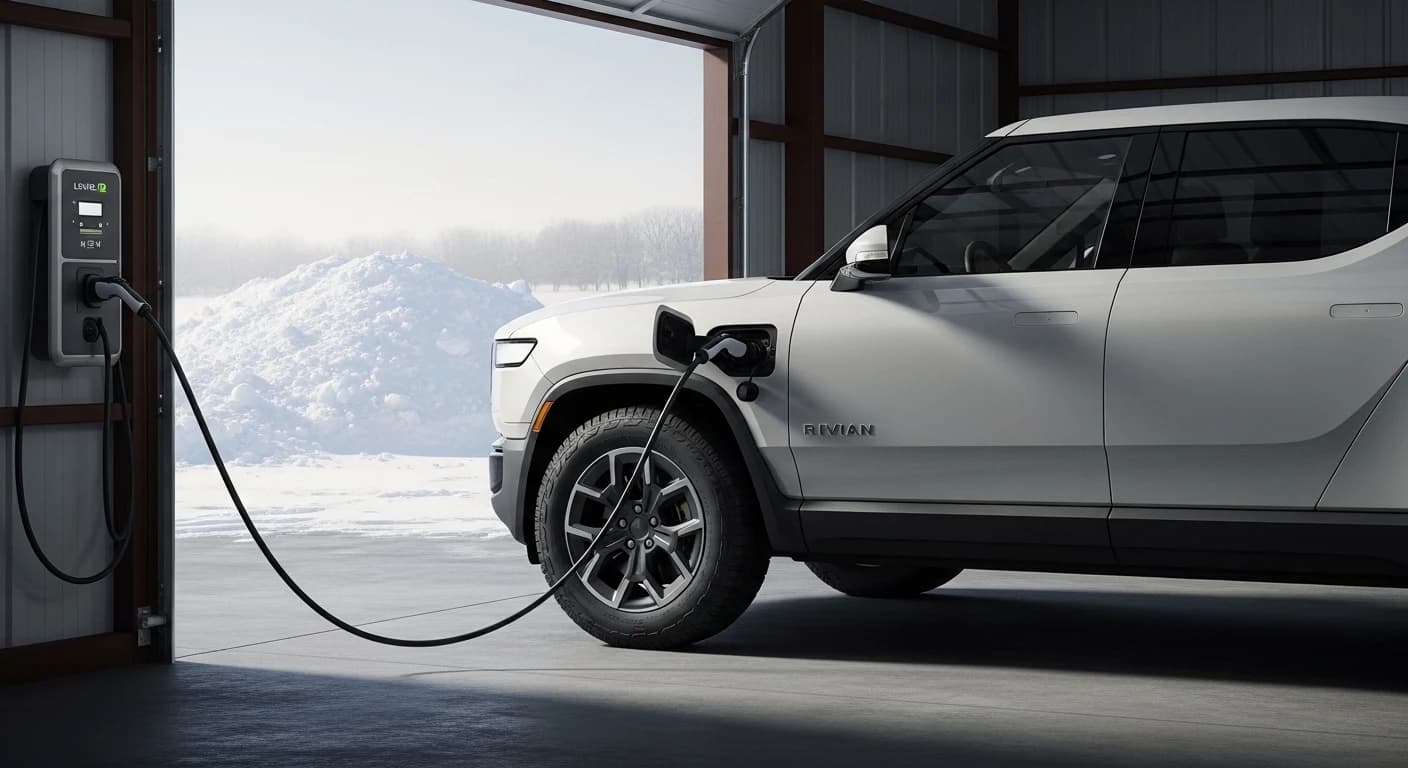
Rivian R1T and R1S vehicles support up to 11.5 kW AC charging on a standard J1772 connection. That is the same ceiling as many other vehicles. The difference from smaller EVs is not the peak charging rate but the total energy needed for a full recovery. A compact EV may need 30-40 kWh to fully charge from daily use. A Rivian may need 60-90 kWh depending on usage, temperature, and trip profile.
Worth noting
Match the charger to Rivian's 11.5 kW onboard limit: a 48-amp charger on a 60-amp dedicated circuit.
Plan for longer daily charging windows — 8 to 12 hours for typical full recovery from daily driving.
Load management systems can be useful in Rivian households where panel capacity is shared with other large loads.
Minnesota winter adds meaningful demand
Cold weather affects large EVs more visibly because the energy consumed by battery heating, cabin conditioning, and four-wheel-drive efficiency represents a larger share of the total range. A Rivian owner in Minnesota who drives 50 miles on a cold day may return home needing significantly more energy restored than the same drive in July.
Worth noting
Budget for 20-30% additional energy demand in winter months when sizing your daily charging window.
Pre-conditioning while plugged in reduces range loss on cold mornings without drawing from the battery.
A charger with reliable cold-weather performance and durable cable handling is worth specifying for outdoor or exposed installs.
Panel requirements for a Rivian-ready setup
A 60-amp dedicated circuit for an 11.5 kW Rivian installation requires meaningful panel headroom. Many Minnesota homes have enough capacity, but a panel assessment should confirm available space and load before finalizing the scope.
Worth noting
A 60-amp dedicated circuit needs a panel with available double-pole breaker space and headroom in the load calculation.
Older Minnesota homes with 100-amp service may need load management or a panel upgrade before supporting this circuit size.
Homes with 200-amp service and primarily gas appliances typically support a 60-amp EV circuit without changes.
Rivian home charging FAQ for Minnesota owners
Common questions from R1T and R1S owners in Minnesota planning a home installation.
Worth noting
What amperage do I need for a Rivian at home? A 48-amp charger on a 60-amp circuit matches the Rivian's 11.5 kW onboard charging rate.
Will Level 2 fully charge my Rivian overnight? For typical daily driving of 40-80 miles, yes. For heavy use days, you may start with partial charge unless the vehicle is plugged in for 10+ hours.
Is a panel upgrade likely? It depends on the home. A 200-amp panel with gas appliances is usually fine. A 100-amp panel or one with high existing loads may require a load management system or service upgrade.
Next step
Ready to plan your install?
Validate panel capacity, circuit path, and mounting location before installation day. Get a clear scope in writing.